

Despite our very recent appearance on the planet, humanity combines arrogance with increasing material demands, even as we become more numerous. Our toughness is a delusion. Have we the intelligence and discipline to vigilantly guard against our tendency to grow without limit?
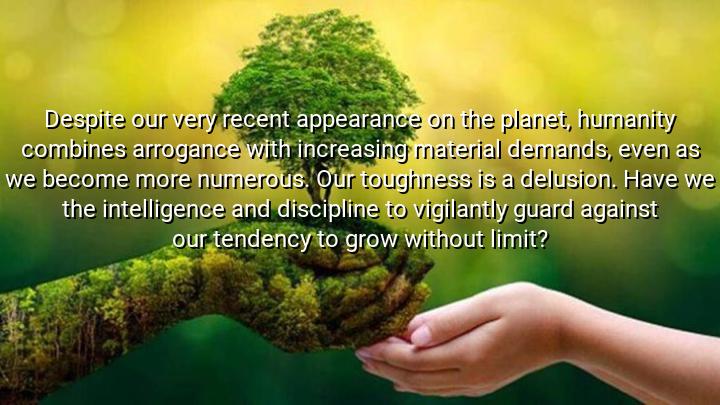




Lynn Margulis’s quote, "Despite our very recent appearance on the planet, humanity combines arrogance with increasing material demands, even as we become more numerous. Our toughness is a delusion. Have we the intelligence and discipline to vigilantly guard against our tendency to grow without limit?" reflects her critical perspective on the nature of humanity and its relationship with the environment. Margulis highlights the arrogance of humans in assuming dominion over the planet, despite our relatively recent existence in the grand scheme of Earth's history. She also points to the increasing material demands of modern society, which grow as the human population expands, raising concerns about the unsustainable nature of such growth.
Margulis also suggests that our perceived toughness as a species—the idea that humanity can survive anything—is a delusion. She argues that this sense of invincibility is unfounded, given the vulnerability of the planet’s ecosystems and our dependence on them for survival. The question she raises about whether we have the intelligence and discipline to regulate our growth and consumption highlights the urgent need for self-awareness and responsibility in addressing environmental challenges. She is urging humanity to reconsider its trajectory and adopt a more sustainable approach to its relationship with the Earth.
The quote underscores a fundamental concern about the limits of growth, echoing the fears of environmental degradation and resource depletion. Margulis’s words challenge us to think critically about the consequences of unchecked human expansion and to question whether we possess the collective wisdom and self-control to prevent ecological disaster. It is a call for discipline in our approach to development and a reminder that progress must be balanced with care for the planet.
The origin of the quote comes from Lynn Margulis, a renowned American biologist and evolutionary theorist, best known for her work on the symbiotic theory of evolution. Margulis’s work focused on the deep interconnectedness of life and the importance of understanding the natural systems that sustain us. Her quote reflects her scientific and philosophical concerns about humanity’s place in the natural world, and her call for a more mindful and responsible approach to our future on Earth.

AAdministratorAdministrator
Welcome, honored guests. Please leave a comment, we will respond soon