

Consider this: I can go to Antarctica and get cash from an ATM without a glitch, but should I fall ill during my travels, a hospital there could not access my medical records or know what medications I am on.
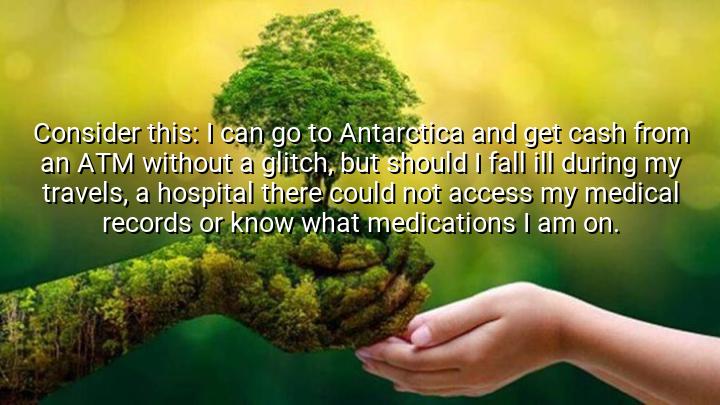




The quote by Nathan Deal highlights the contrast between technological convenience and medical preparedness. Deal observes that even in a remote place like Antarctica, accessing cash from an ATM works flawlessly, reflecting the efficiency of modern financial systems. However, he points out that if someone were to fall ill, the medical infrastructure would face significant limitations, as hospitals would not have access to medical records or medication histories.
At the core of the quote is the idea of systemic disparity between everyday conveniences and critical healthcare needs. While technology has made tasks like financial transactions seamless across the globe, medical systems often remain fragmented, leaving gaps in patient care during emergencies or travel. This highlights the vulnerability of individuals relying on disparate healthcare networks.
The quote also emphasizes the importance of accessible health information. Deal’s reflection illustrates that efficient data sharing and interoperability in healthcare systems are essential for ensuring patient safety, particularly in remote or unfamiliar locations. It points to the need for improvements in global medical record management and communication among healthcare providers.
The origin of this quote comes from Nathan Deal, a former Governor of Georgia, discussing the challenges and limitations of healthcare infrastructure in comparison to modern technological conveniences. His statement underscores the contrast between the global efficiency of everyday systems like ATMs and the critical gaps in medical preparedness, highlighting the need for innovation and integration in healthcare technology.
I can also create a concise 2-3 sentence version suitable for social media or quick reference if you want.

AAdministratorAdministrator
Welcome, honored guests. Please leave a comment, we will respond soon