

Conscience is the root of all true courage; if a man would be brave let him obey his conscience.
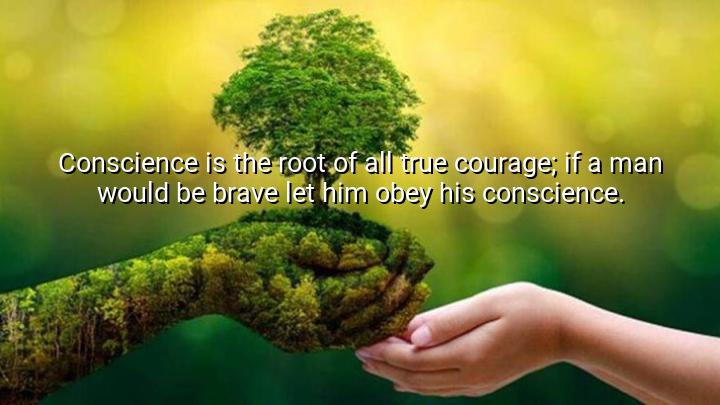




James Freeman Clarke’s quote suggests that conscience is the foundation of true courage. He argues that genuine bravery is not about physical strength or the absence of fear, but about the willingness to act according to one’s moral beliefs, even in the face of adversity. For Clarke, courage is an internal quality that comes from aligning actions with what one believes to be right, regardless of external pressures or consequences.
The quote implies that a person who follows their conscience—their inner sense of right and wrong—will naturally exhibit bravery. In times of challenge, it is not fearlessness that defines courage, but the ability to stand firm in one’s convictions, even when it may be difficult or unpopular. This kind of courage is grounded in moral integrity rather than mere physical action.
The origin of this thought stems from Clarke’s deep involvement in religious and philosophical thinking. As a prominent Unitarian minister and theologian, Clarke often explored themes of morality, ethics, and personal responsibility. His works encourage individuals to live according to their principles and moral compass, seeing courage as an expression of this deeper sense of responsibility.
Ultimately, Clarke’s quote reinforces the idea that true courage arises not from external heroics, but from the inner strength to act according to what one believes is right. It encourages individuals to trust their conscience and embrace the courage to make difficult decisions, even when faced with opposition or fear.

AAdministratorAdministrator
Welcome, honored guests. Please leave a comment, we will respond soon