

Civilizations are not remembered by their business people, their bankers or lawyers. They're remembered by the arts.
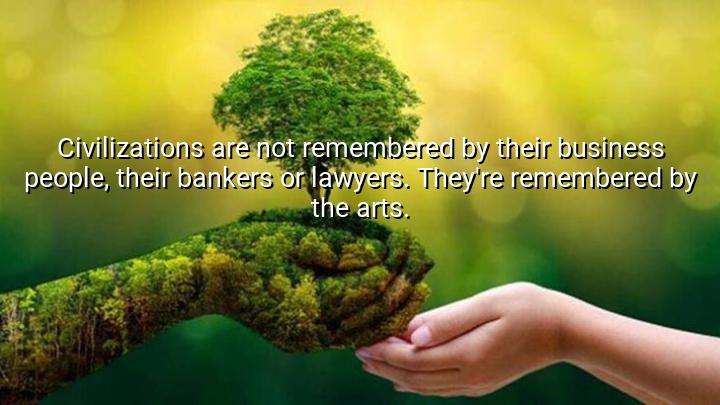




This quote by Eli Broad, an American entrepreneur, philanthropist, and passionate supporter of the arts, highlights the enduring cultural value of creativity and artistic expression. When Broad says, “Civilizations are not remembered by their business people, their bankers or lawyers,” he’s not dismissing those professions, but rather emphasizing that what stands the test of time—and defines the legacy of a society—is its art, music, architecture, and literature.
As a successful businessman himself, Broad had a deep understanding of the importance of commerce and law in building societies. However, his quote reflects a broader perspective: while economic systems and legal frameworks support the structure of a civilization, it is the arts that give it soul, identity, and immortality. Civilizations like Ancient Greece, the Roman Empire, or the Renaissance period are remembered more for their sculptures, paintings, and philosophy than for their financial systems.
Eli Broad invested significantly in the arts, helping to fund institutions such as The Broad museum in Los Angeles and supporting artists and cultural programs around the world. His advocacy was rooted in the belief that art inspires, educates, and connects people across generations and cultures. His quote reinforces the idea that cultural contributions outlive economic achievements and are what future generations look to when understanding the past.
Ultimately, Broad’s statement serves as a powerful reminder of the transformative power of the arts. While business, banking, and law are essential for daily functioning, it is the creative achievements—the music, the paintings, the stories—that shape how civilizations are remembered, celebrated, and understood in the historical record.

AAdministratorAdministrator
Welcome, honored guests. Please leave a comment, we will respond soon