

Christ shared our experience; he suffered as we suffer; he died as we shall die, and for forty days in the desert he underwent the struggle between good and evil.
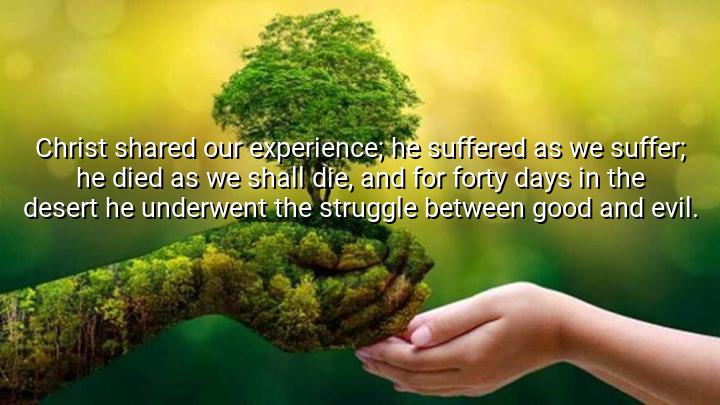




The quote by Basil Hume, "Christ shared our experience; he suffered as we suffer; he died as we shall die, and for forty days in the desert he underwent the struggle between good and evil," reflects the central Christian belief in the humanity of Christ. By emphasizing that Christ experienced suffering, death, and temptation, Hume highlights the idea that Jesus was not distant from human struggles but fully shared in them. This makes Christ a source of comfort and strength, as believers see in him someone who truly understands their own challenges.
The meaning of the quote is rooted in the belief that Christ’s life was both divine and human. His suffering and death parallel human mortality, while his forty days in the desert symbolize the universal human struggle against temptation and evil. For Christians, this connection means that Christ is not just a savior in theory but a companion in every trial of life. It assures believers that they are not alone in their hardships, for Christ himself has walked the same path.
The origin of the idea comes from biblical accounts in the New Testament, especially the Gospels, which describe Christ’s temptation in the wilderness, his passion, and his death on the cross. Basil Hume, a 20th-century English Cardinal and Archbishop of Westminster, was known for his pastoral writings that made theology accessible. His words draw directly from Scripture, presenting the life of Jesus as both a model and a mystery of shared humanity and divine purpose.
Ultimately, the quote serves as a reminder of the solidarity of Christ with humanity. It emphasizes that Christian faith is not only about worshiping a distant God but about following one who entered fully into human life, faced suffering, and overcame evil. This message remains powerful in times of difficulty, encouraging believers to endure with hope, knowing that Christ has already faced and triumphed over the same struggles.

AAdministratorAdministrator
Welcome, honored guests. Please leave a comment, we will respond soon