

Children need to have both time to think and the motivation to think for themselves, to develop an expert reading brain, before the digital mode dominates their reading. The immediacy and volume of information should not be confused with true knowledge.
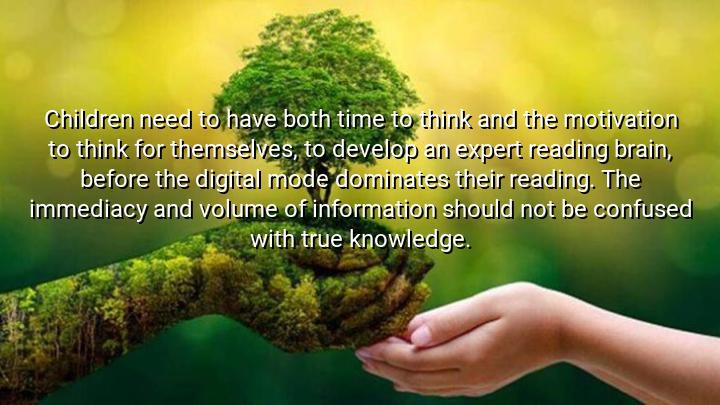




The quote by Maryanne Wolf, "Children need to have both time to think and the motivation to think for themselves, to develop an expert reading brain, before the digital mode dominates their reading. The immediacy and volume of information should not be confused with true knowledge," emphasizes the importance of deep reading and critical thinking in child development. Wolf highlights that developing an expert reading brain requires time, reflection, and self-driven curiosity—skills that risk being diminished by the speed and distraction of the digital age.
The origin of this statement comes from Wolf’s work as a cognitive neuroscientist and author, particularly in her book Reader, Come Home: The Reading Brain in a Digital World. Her research explores how the brain adapts to different modes of reading, from traditional print to digital media. She warns that while digital tools provide unprecedented access to information, they can also encourage surface-level reading rather than deep comprehension and analysis.
The deeper meaning of the quote is that information and knowledge are not the same. Children exposed primarily to fast-paced, digital reading may mistake the sheer amount of data they encounter for true understanding. Wolf argues that without the ability to slow down, reflect, and critically evaluate, children risk losing the cognitive benefits of sustained reading—such as empathy, reasoning, and problem-solving.
Ultimately, Wolf’s words serve as a call for balance between traditional reading and digital learning. She advocates giving children the time and motivation to cultivate thoughtful reading habits before the dominance of screens reshapes their cognitive patterns. Her quote reminds us that the goal is not just to process information quickly but to develop a mind capable of turning it into meaningful knowledge.

AAdministratorAdministrator
Welcome, honored guests. Please leave a comment, we will respond soon