

But maybe music was not intended to satisfy the curious definiteness of man. Maybe it is better to hope that music may always be transcendental language in the most extravagant sense.
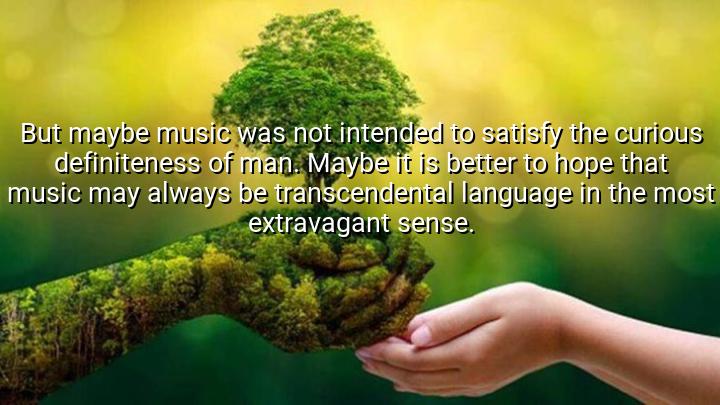




Charles Ives’s quote reflects his belief that music is not simply a tool for satisfying human curiosity or offering clear, definitive answers. Instead, he suggests that music may serve as a transcendental language—a means of communication that goes beyond the limitations of spoken or written words. By calling it "transcendental," Ives implies that music has the power to evoke emotions, ideas, and experiences that transcend the mundane and rational, offering something more mysterious and infinite. Music, in this view, is not meant to fulfill the curiosity of man with exactness, but to evoke feeling, imagination, and spiritual insight.
Ives, an American composer, was known for his innovative and avant-garde approach to music. His works often broke away from conventional forms and harmonies, seeking to capture the complexity of human experience and the vastness of the world through sound. In this quote, he hints that music’s true power lies in its abstract and emotional qualities, which can communicate on a deeper level than any structured language. For Ives, music’s beauty comes not from its ability to answer questions or provide clarity but from its capacity to elicit a transcendental experience that is beyond logic.
The quote also suggests that music is more than a form of entertainment or intellectual pursuit; it is a medium that can reach into the mystical or spiritual realms, offering an expression that may not always be easily understood or defined. The phrase "in the most extravagant sense" suggests that music has the potential to be wild, expansive, and unrestrained, creating a space where listeners can experience a sense of wonder or awe that is not confined by rationality or expectations.
The origin of this quote lies in Ives's broader philosophy about the nature of art and music. As a composer who often experimented with dissonance, unconventional structures, and the blending of varied musical styles, Ives viewed music as a powerful means of transcending the ordinary, offering a deeper, more profound connection to both the individual and the universal. His works and ideas reflect a belief that art—and music in particular—has the power to reach beyond the limits of human understanding, offering a more mystical and transcendent experience.

AAdministratorAdministrator
Welcome, honored guests. Please leave a comment, we will respond soon