

But I am not going to live for ever. And the more I know it, the more amazed I am by being here at all.
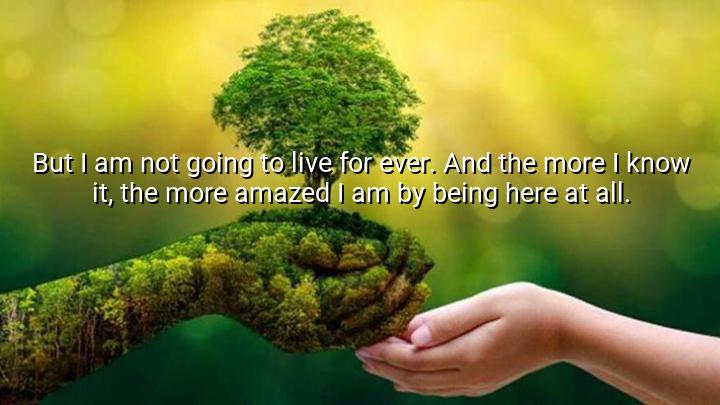




The quote by William Hurt — "But I am not going to live forever. And the more I know it, the more amazed I am by being here at all." — reflects a deep sense of awareness and gratitude for life. Hurt is acknowledging the inevitable reality of mortality, but rather than viewing it with sadness or fear, he expresses a sense of awe at the mere fact of existence. As he becomes more conscious of his own finite time, he is increasingly amazed by the experience of living, emphasizing how precious and fleeting life truly is.
Hurt's words highlight the connection between mortality and the appreciation for life. The awareness that life is temporary often leads to a heightened sense of appreciation for the present moment. By recognizing that we don’t have unlimited time, we may start to value our experiences and the world around us in a more profound way. His statement suggests that it is the knowledge of our impermanence that makes the act of living feel even more significant and awe-inspiring.
The origin of this quote likely stems from Hurt's personal reflections on his own life and career. As an actor, Hurt has spent much of his life exploring deep, existential themes through his work, which may have prompted him to reflect on the nature of existence. His experiences with both personal and professional challenges likely contribute to his perspective on life, mortality, and the human condition.
Ultimately, Hurt's quote encourages us to appreciate life’s fragility and to embrace the wonder of being alive. The more we understand that our time is limited, the more we may find ourselves grateful for the opportunity to live, experience, and connect with others. His words serve as a reminder to live fully and with a sense of amazement at the simple fact of being here at all.

Ooooooowoooooo
Honestly, this makes me want to slow down. We’re always in such a rush—plans, deadlines, future goals. But what if the whole point is just to notice that we’re even here in the first place? That awareness seems both liberating and overwhelming. How do we hold onto that feeling of amazement in everyday routines without it fading back into background noise?
DAdang duy anh
I really respect the humility in this quote. It’s a quiet celebration of life, not through achievement or success, but just through the miracle of existence. But it raises a philosophical question—if being alive is so astonishing, why do we spend so much of our time distracted, angry, or discontent? Do we forget how rare and unlikely our very being is?
VDTung Vu dinh
This line makes me think about aging and how time seems to speed up the older we get. I’m curious—do you think people in their youth are even capable of relating to this kind of existential awe? Or does it take decades of living, maybe some pain and loss too, to feel genuinely amazed that we get to experience life at all?
TLNguyen Ngoc Thien Ly
I find this idea so grounding. The deeper our understanding of life’s temporary nature, the more wonder we might feel just existing in this world. But then again, does this realization lead some to anxiety instead of amazement? What separates those who feel awe from those who feel dread? Is it a matter of mindset, or are some people just more naturally inclined to feel inspired by impermanence?
TDThuong Dang
There’s a strange comfort in this—acknowledging that we’re not permanent, and yet somehow finding joy in just being. I sometimes wonder if this awareness is the key to peace of mind. Why do you think so many people run from the idea of their own mortality when it can make life feel more precious? Could embracing that truth make us live more authentically or even more bravely?