

Biomimicry is basically taking a design challenge and then finding an ecosystem that's already solved that challenge, and literally trying to emulate what you learn.
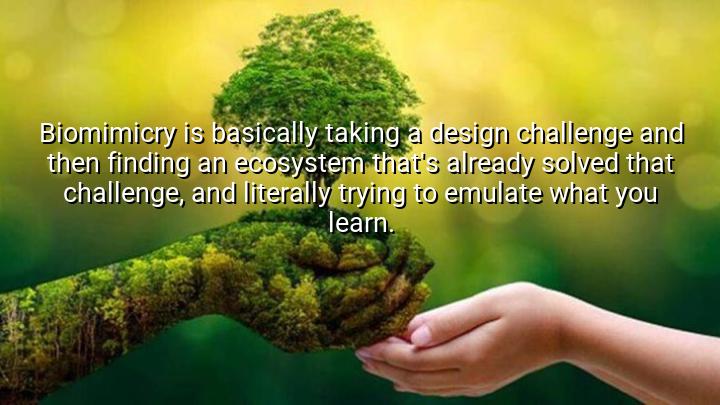




The quote by Janine Benyus—“Biomimicry is basically taking a design challenge and then finding an ecosystem that's already solved that challenge, and literally trying to emulate what you learn.”—captures the essence of her pioneering work in the field of biomimicry. Benyus defines it as the practice of turning to nature for inspiration when solving human design problems. Instead of creating solutions from scratch, designers and engineers study how natural systems have already perfected responses to challenges over millions of years of evolution.
The meaning of the quote lies in its emphasis on learning from nature as a mentor rather than exploiting it as a resource. Benyus suggests that every design challenge humans face—such as efficiency, resilience, or sustainability—has likely already been addressed in some form by plants, animals, or ecosystems. By studying and emulating these models, humans can create technologies and systems that are more sustainable, efficient, and harmonious with the environment. This approach reframes innovation as an act of humility and observation rather than domination.
The origin of this perspective comes from Benyus’s influential book Biomimicry: Innovation Inspired by Nature (1997). In it, she formalized the concept of biomimicry as a discipline that brings together biology, design, and engineering. Her work inspired industries ranging from architecture to product design and materials science, encouraging innovators to look at how natural systems filter water, harness energy, or adapt to stress. The book marked a turning point in ecological thinking, shifting the narrative from exploiting nature to collaborating with it.
In a broader sense, Benyus’s words highlight the transformative potential of biomimicry for addressing modern challenges like climate change, resource scarcity, and environmental degradation. By recognizing that ecosystems already embody sustainable solutions, humans can move away from wasteful, extractive models of design toward approaches rooted in efficiency and balance. Her definition continues to inspire a new generation of designers, scientists, and policymakers to see nature as a guide, ultimately shaping a vision of innovation that works with, rather than against, the planet.
Would you like me to also give specific examples of biomimicry in action—such as Velcro, wind turbines inspired by whales, or water collection systems modeled on desert beetles?

AAdministratorAdministrator
Welcome, honored guests. Please leave a comment, we will respond soon