

Behaving morally because of a hope of reward or a fear of punishment is not morality. Morality is not bribery or threats. Religion is bribery and threats. Humans have morality. We don't need religion.
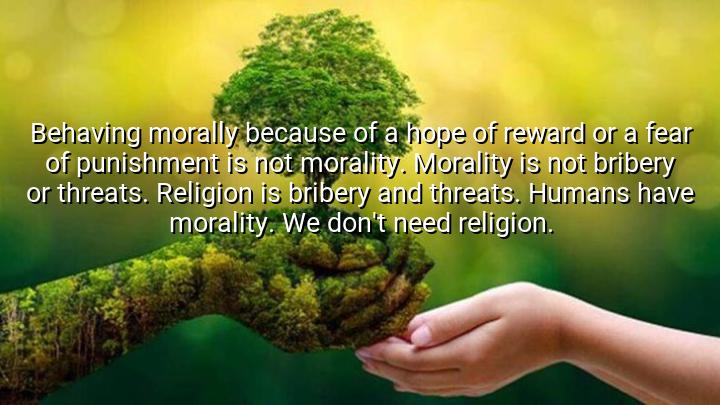




The quote "Behaving morally because of a hope of reward or a fear of punishment is not morality. Morality is not bribery or threats. Religion is bribery and threats. Humans have morality. We don't need religion" by Penn Jillette, an American magician and outspoken atheist, argues that true morality is independent of religious beliefs or external incentives like rewards or punishments. Jillette suggests that people should act morally because it is the right thing to do, not because they expect a reward (such as an afterlife or material gain) or fear a punishment (such as damnation or retribution). He views these motivations as forms of manipulation rather than true moral behavior.
Jillette's words reflect his belief in human morality as an inherent quality that exists independently of religion. He challenges the idea that religious beliefs are necessary for people to be moral or to live ethical lives. Instead, he asserts that morality comes from within human beings, shaped by reason, empathy, and the desire to live harmoniously with others. He equates religion with forms of bribery and threats because, in his view, it uses the promise of rewards or the fear of punishments to encourage moral behavior, which he believes is not genuine morality.
The origin of this quote stems from Jillette’s broader worldview, which is often critical of religion and its influence on human behavior. As an atheist and skeptic, Jillette frequently speaks out against what he perceives as the harmful aspects of organized religion, arguing that people can live moral lives without religious frameworks. His perspective suggests that humans are fully capable of discerning right from wrong through reason and empathy, without needing to rely on religious doctrines or divine threats.
Ultimately, Jillette’s quote emphasizes his belief in human autonomy and the capacity to live morally based on humanistic principles rather than external religious controls. His challenge to the link between religion and morality invites individuals to think critically about their motivations for moral behavior and to consider the possibility of a secular ethics that is based on shared values rather than fear or reward.

AAdministratorAdministrator
Welcome, honored guests. Please leave a comment, we will respond soon