

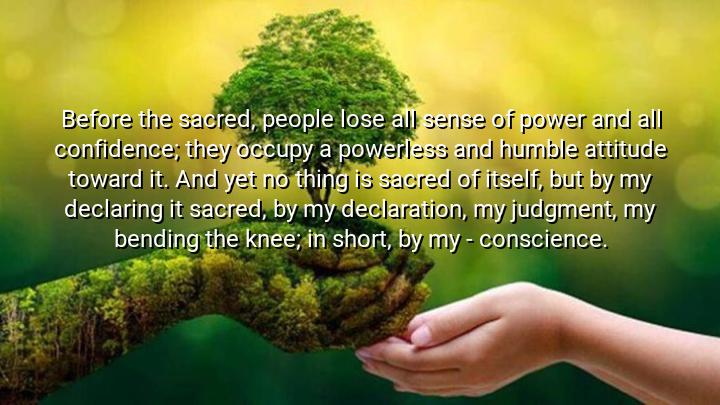
Before the sacred, people lose all sense of power and all confidence; they occupy a powerless and humble attitude toward it. And yet no thing is sacred of itself, but by my declaring it sacred, by my declaration, my judgment, my bending the knee; in short, by my - conscience.
Before the sacred, people lose all
Before the sacred, people lose all sense of power and all confidence; they occupy a powerless and humble attitude toward it. And yet no thing is sacred of itself, but by my declaring it sacred, by my declaration, my judgment, my bending the knee; in short, by my - conscience.

Before the sacred, people lose all
Before the sacred, people lose all sense of power and all confidence; they occupy a powerless and humble attitude toward it. And yet no thing is sacred of itself, but by my declaring it sacred, by my declaration, my judgment, my bending the knee; in short, by my - conscience.
Before the sacred, people lose all
Before the sacred, people lose all sense of power and all confidence; they occupy a powerless and humble attitude toward it. And yet no thing is sacred of itself, but by my declaring it sacred, by my declaration, my judgment, my bending the knee; in short, by my - conscience.
Before the sacred, people lose all
Before the sacred, people lose all sense of power and all confidence; they occupy a powerless and humble attitude toward it. And yet no thing is sacred of itself, but by my declaring it sacred, by my declaration, my judgment, my bending the knee; in short, by my - conscience.
Before the sacred, people lose all
Before the sacred, people lose all sense of power and all confidence; they occupy a powerless and humble attitude toward it. And yet no thing is sacred of itself, but by my declaring it sacred, by my declaration, my judgment, my bending the knee; in short, by my - conscience.
Before the sacred, people lose all

The quote by Max Stirner explores the complex relationship between individuals and the concept of the sacred. He observes that before something deemed sacred, people often lose their sense of power and confidence, adopting a powerless and humble attitude. However, Stirner challenges the notion that anything is inherently sacred, arguing that something becomes sacred only through an individual's declaration, judgment, and conscious conscience—a personal act of giving meaning and reverence.

The meaning behind the quote emphasizes that the sacred is not an objective quality but a subjective creation of the mind. Stirner suggests that what we consider sacred is a result of our own choices and attitudes, highlighting the power of individual will in shaping beliefs and values. This perspective encourages a critical view of traditional notions of sacredness, advocating for personal responsibility in how we assign meaning.

The origin of this quote comes from Max Stirner, a 19th-century German philosopher known for his radical individualism and critique of social and religious institutions. Stirner’s philosophy centers on the autonomy of the individual and the rejection of imposed ideals, making this reflection on the sacred a key part of his broader argument against external authority.

In summary, Max Stirner’s quote teaches that the attitude toward the sacred is rooted in individual conscience and personal judgment. It challenges us to recognize that sacredness is a human construct, shaped by our own declarations and beliefs rather than inherent qualities.

Max Stirner
Max Stirner

German - Philosopher October 25, 1806 - June 26, 1856

Have 0 Comment Before the sacred, people lose all

AAdministratorAdministrator

Welcome, honored guests. Please leave a comment, we will respond soon

Reply.
Information sender
Leave the question
Click here to rate
Information sender
0.16452 sec| 2553.555 kb