

Beauty seen is never lost, God's colors all are fast.
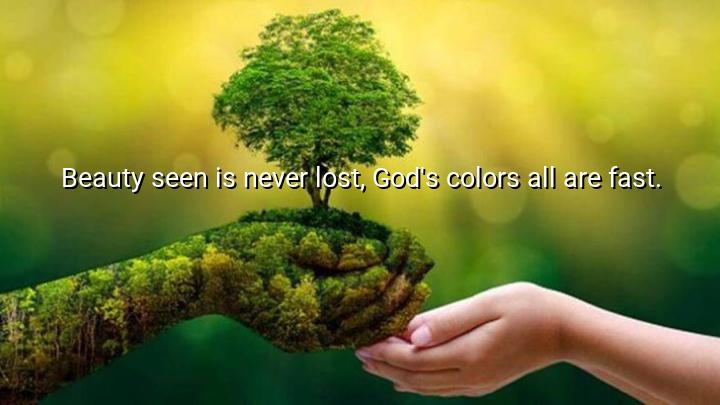




In this quote, John Greenleaf Whittier reflects on the enduring nature of beauty and how it leaves a lasting impression, even after it is no longer physically present. When he says, "Beauty seen is never lost," he suggests that once we have experienced beauty—whether in nature, art, or human interaction—it remains with us, having made a permanent mark on our memory and spirit. The beauty we encounter shapes our thoughts and feelings, and its influence continues to resonate long after the moment has passed.
Whittier continues with the phrase "God's colors all are fast," which implies that the beauty found in the natural world, created by God, is constant and unchanging. The term "fast" here suggests permanence, meaning that the beauty of the world, like the colors of nature, is eternal and unwavering. This can be interpreted as a reminder that even as individual experiences of beauty may fade, the beauty inherent in the world—guided by divine creation—remains constant and timeless.
The origin of this quote comes from Whittier's broader body of work, which often explored themes of nature, spirituality, and the sublime beauty found in the world around us. As a Quaker poet and social activist, Whittier found inspiration in the simplicity and purity of nature, seeing it as a reflection of divine grace and creation. His poetry often celebrated the idea that beauty in the world carries a spiritual significance.
Ultimately, the quote serves as a reminder that while physical beauty may be temporary, the beauty we experience through the world around us and within ourselves is lasting. It encourages us to appreciate the fleeting moments of beauty, knowing that their impact endures in our hearts and minds, while the beauty of the world, shaped by divine forces, remains forever.

AAdministratorAdministrator
Welcome, honored guests. Please leave a comment, we will respond soon