

Beauty is an ecstasy; it is as simple as hunger. There is really nothing to be said about it. It is like the perfume of a rose: you can smell it and that is all.
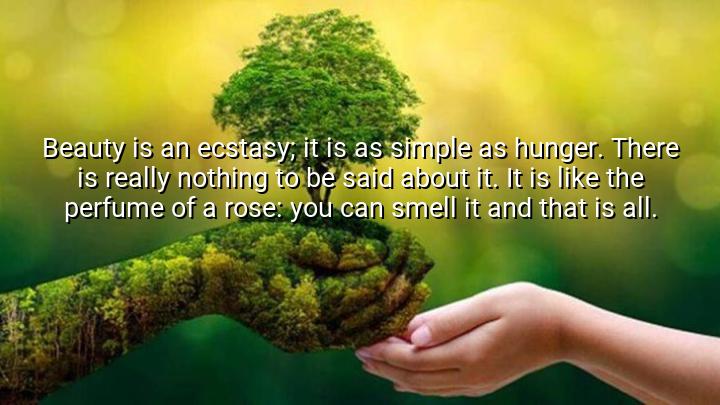




In the quote by W. Somerset Maugham, "Beauty is an ecstasy; it is as simple as hunger. There is really nothing to be said about it. It is like the perfume of a rose: you can smell it and that is all," Maugham emphasizes the intangible and immediate nature of beauty. He compares it to a basic, primal need like hunger, suggesting that beauty, like the sensation of hunger, is something that is deeply felt but not easily described. Just as you can feel hunger or smell the perfume of a rose without needing further explanation, beauty is something that can only be experienced directly, without the need for words or analysis.
The origin of this quote comes from Maugham's philosophy on art and life. As a writer and playwright, Maugham often explored the complexities of human experience, including our perceptions of beauty, pleasure, and emotion. He believed that beauty was something that transcended intellect and was rooted in the experience itself. In his works, Maugham frequently touched on the idea that some things in life, like beauty, are felt deeply but cannot be fully articulated or explained.
Maugham's comparison of beauty to the perfume of a rose further reinforces his view of beauty as a fleeting, sensory experience. Just as the fragrance of a rose cannot be captured in words, true beauty cannot be adequately described—its value is in the direct experience. This perspective encourages a more visceral, emotional response to beauty, rather than one that seeks to analyze or categorize it.
Ultimately, this quote highlights Maugham’s belief that beauty is a profound yet simple experience that doesn’t need justification or intellectualization. Instead, it should be appreciated in the moment, as it is—a source of ecstasy that evokes emotion and admiration without requiring explanation. For Maugham, the essence of beauty lies in the experience itself, much like the primal sensations of hunger or scent.

AAdministratorAdministrator
Welcome, honored guests. Please leave a comment, we will respond soon