

Be not a slave of words.
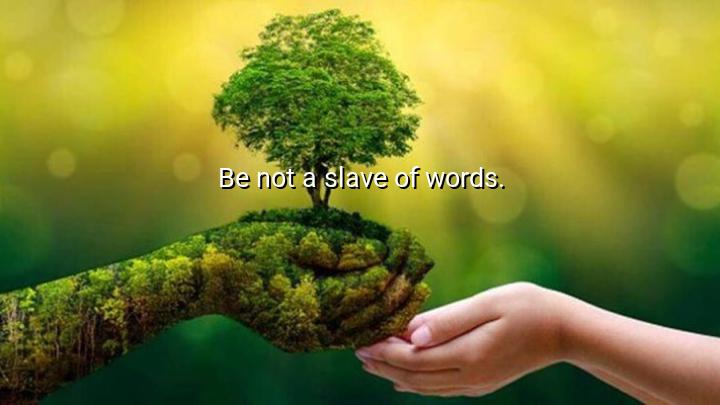




The quote “Be not a slave of words.” by Thomas Carlyle urges individuals to avoid becoming overly dependent on or limited by language alone. Carlyle, a 19th-century Scottish historian, essayist, and philosopher, often emphasized action, truth, and authenticity over superficial expression. In this brief but impactful quote, he warns against treating words as an end in themselves, rather than as a means to convey deeper thought, feeling, or reality.
To be a “slave of words” means to focus so much on the form of communication—eloquence, terminology, or style—that one loses sight of substance. Carlyle saw this as a dangerous habit, especially in intellectual or political life, where flowery speech or clever rhetoric might replace genuine insight or moral conviction. He believed that language should serve truth and action, not become a distraction or a disguise for emptiness.
This quote reflects Carlyle’s broader critique of modern society, which he often saw as obsessed with appearances, bureaucracy, and hollow formalities. In works like Sartor Resartus and On Heroes, Hero-Worship, and The Heroic in History, he called for a return to inner strength, spiritual depth, and honest labor—values he felt were often drowned out by mere talk. His distrust of idle verbosity was tied to a larger philosophy that valued character over cleverness.
Ultimately, Carlyle’s message remains relevant in a world where words are easily multiplied—through media, marketing, and social platforms—but not always matched by authentic meaning or action. His quote reminds us to use language thoughtfully, not to be controlled by it, and to focus on truth, purpose, and deed rather than empty expression.

AAdministratorAdministrator
Welcome, honored guests. Please leave a comment, we will respond soon