

Basically, the person in the White House should be principled, should have a philosophy about food that relates directly to organic agriculture. I will continue to push for that.
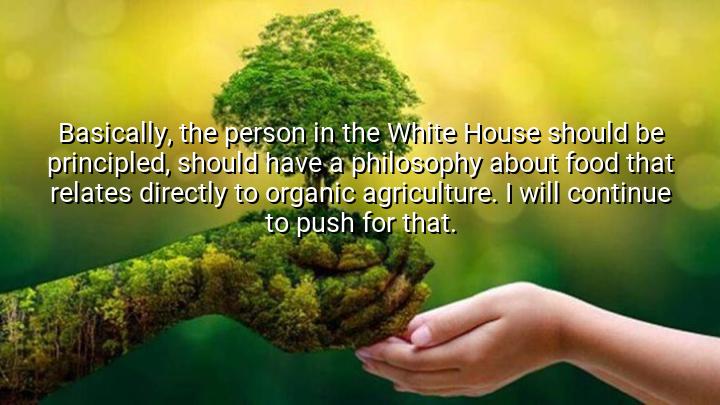




The quote "Basically, the person in the White House should be principled, should have a philosophy about food that relates directly to organic agriculture. I will continue to push for that." by Alice Waters expresses her deep conviction that food policy and agricultural values should be central to national leadership. Waters, a pioneering chef, restaurateur, and organic food advocate, is best known for founding Chez Panisse and launching the Edible Schoolyard Project, both of which promote seasonal, sustainable, and organic eating. In this quote, she calls for political leaders—especially the President—to embrace and champion the principles of organic agriculture as part of their broader ethical platform.
By insisting that the occupant of the White House be principled and have a food philosophy, Waters is emphasizing that how we grow, prepare, and consume food is not just a personal choice but a political and moral issue. She believes that organic farming—which avoids synthetic pesticides, promotes soil health, and respects ecological balance—should not only be supported by citizens, but institutionalized at the highest level of government. This perspective aligns with her lifelong mission to elevate food consciousness as a cornerstone of public health, environmental sustainability, and social justice.
Waters has long been a vocal proponent of integrating real food values into public institutions, including school lunch programs, urban planning, and environmental legislation. Her continued advocacy, as referenced in the quote, suggests that her push for organic ideals in national policy is ongoing and non-negotiable. She views food not just as nourishment, but as a reflection of values, and she believes that national leaders should reflect and promote those values through their policy decisions.
In essence, the quote encapsulates Waters’s belief that leadership, morality, and food are deeply interconnected. She argues that a principled president should not be indifferent to the origins and impact of food systems, but rather take an active role in transforming agriculture into a force for good. Her vision positions organic agriculture not as a trend, but as a necessary philosophy for guiding responsible governance and ensuring a healthier, more sustainable future.

AAdministratorAdministrator
Welcome, honored guests. Please leave a comment, we will respond soon