

Atheists have to live with the knowledge that there is no salvation, no redemption, no second chances. Lives can go terribly wrong in ways that can never be put right.
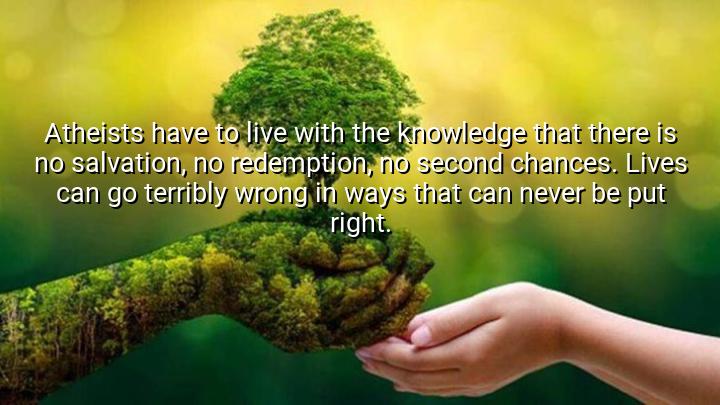




The quote “Atheists have to live with the knowledge that there is no salvation, no redemption, no second chances. Lives can go terribly wrong in ways that can never be put right.” by Julian Baggini captures the existential reality of life without belief in a higher power. For atheists, there is no expectation of salvation or a divine system of redemption to correct mistakes after death. Instead, they must confront life as finite and often irreversible, where decisions and consequences hold absolute weight.
By emphasizing the absence of second chances, Baggini highlights the sobering responsibility that atheists carry. Without the comfort of an afterlife or divine forgiveness, they must seek meaning and morality within the boundaries of this one life. This worldview recognizes that things can go “terribly wrong” and remain unresolved, yet it also encourages individuals to value their choices deeply, since every action has lasting significance.
The origin of this perspective lies in Baggini’s role as a philosopher and writer who often explores questions of atheism, ethics, and humanism. In his works, he argues that a life without belief in God is not empty but rather grounded in personal responsibility and authenticity. His reflections point out that while religion offers comfort through redemption and eternal hope, atheism demands facing reality directly, however difficult that may be.
In essence, Baggini’s quote illustrates the philosophical tension of atheism: the absence of cosmic forgiveness may feel harsh, but it also fosters honesty and accountability. It challenges people to live with greater awareness, knowing that this life is the only one they have, and that meaning must be created rather than received.

AAdministratorAdministrator
Welcome, honored guests. Please leave a comment, we will respond soon