

As long as the people don't fear the truth, there is hope. For once they fear it, the one who tells it doesn't stand a chance. And today, truth is still beautiful... but so frightening.
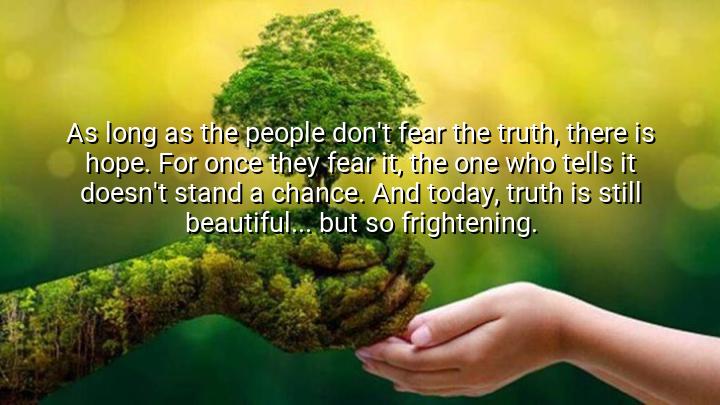




In this quote, Alice Walker reflects on the power of truth and the relationship between truth-telling and fear. She suggests that as long as people are not afraid of the truth, there is hope for societal progress and freedom. However, once fear takes hold and people become afraid to confront or accept the truth, those who speak it—whether they are activists, leaders, or everyday individuals—are at risk of being silenced or oppressed. Walker highlights the beauty of truth, while acknowledging its capacity to provoke fear, especially when it challenges established norms or uncomfortable realities.
The origin of this quote comes from Alice Walker, an acclaimed American writer, poet, and activist best known for her novel The Color Purple. Walker has long been an advocate for human rights, social justice, and the empowerment of marginalized groups, particularly African American women. Her work often addresses difficult truths about racism, gender inequality, and injustice. This quote reflects her belief in the importance of truth-telling as a tool for liberation, even when it is uncomfortable or threatening.
Walker’s statement also speaks to the courage it takes to speak the truth in a world where it may be met with hostility or suppression. She underscores that while truth remains inherently beautiful, it is also frightening because it can disrupt the status quo and force society to face harsh realities. In this sense, truth can be a double-edged sword—powerful and necessary, yet deeply unsettling for those who have built their lives or systems around lies or denial.
Ultimately, this quote is a call to embrace truth despite its discomforting nature. Walker reminds us that when we are no longer afraid to confront the truth, we have the potential to transform our world. She suggests that the fear of truth can prevent change and growth, while its acceptance can lead to a more honest, just, and hopeful future.

AAdministratorAdministrator
Welcome, honored guests. Please leave a comment, we will respond soon