

As dry leaves that before the wild hurricane fly, when they meet with an obstacle, mount to the sky. So up to the house-top the coursers they flew, with the sleigh full of toys, and St. Nicholas too.
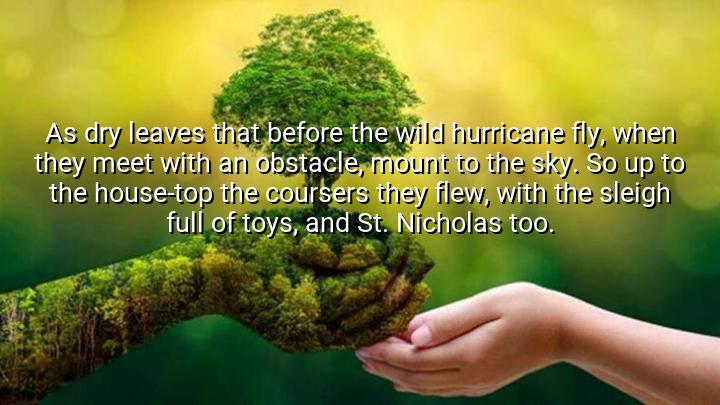




Clement Clarke Moore’s quote, from his famous poem “A Visit from St. Nicholas” (commonly known as “The Night Before Christmas”), uses vivid imagery to describe the arrival of Santa Claus and his sleigh. The comparison to dry leaves being swept by a hurricane suggests the speed and force with which Santa’s sleigh travels through the air, moving with such power that when it meets an obstacle, it mounts to the sky. This imagery conveys a sense of magic and effortlessness as Santa and his coursers (reindeer) ascend toward the house-top, delivering gifts to children.
The origin of the quote is rooted in Moore’s 1823 poem, which has become one of the most beloved and enduring Christmas traditions in Western culture. Moore’s poem was instrumental in shaping the modern image of Santa Claus, depicting him not just as a jolly gift-giver, but as a figure capable of magical feats like flying through the sky in a sleigh full of toys. The poem helped to solidify the mythology of Santa’s annual Christmas Eve journey.
The use of dynamic imagery in the quote highlights the magical nature of the holiday. The sleigh’s flight is described as almost supernatural, soaring above obstacles with ease, symbolizing the joy and wonder that Christmas brings to children. Santa’s ability to defy gravity and deliver gifts around the world reflects the childlike sense of possibility and enchantment that defines the Christmas season.
In conclusion, Moore’s words capture the whimsical and magical qualities of the Christmas season. Through his creative description of Santa’s sleigh flying over rooftops, he instills a sense of awe and excitement, emphasizing the fantastical nature of Santa’s Christmas Eve journey. This imagery continues to evoke the spirit of Christmas—a time of joy, wonder, and the belief in magic.

AAdministratorAdministrator
Welcome, honored guests. Please leave a comment, we will respond soon