

Anything in any way beautiful derives its beauty from itself and asks nothing beyond itself. Praise is no part of it, for nothing is made worse or better by praise.
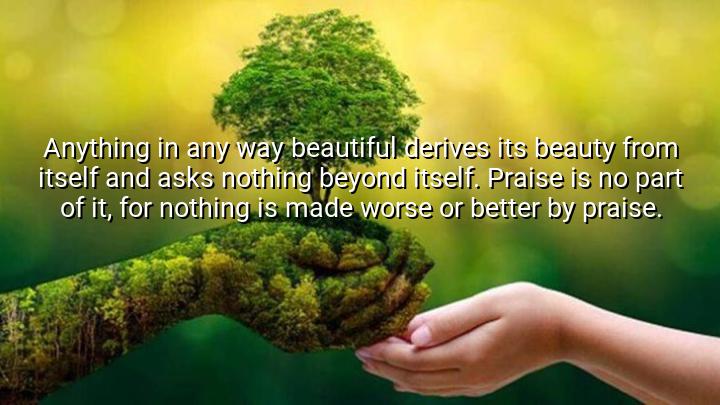




In this quote, Marcus Aurelius, the Roman Emperor and Stoic philosopher, explores the intrinsic nature of beauty. He suggests that true beauty does not rely on external validation or praise. Anything that is genuinely beautiful, whether it is a person, an object, or a natural phenomenon, possesses beauty within itself. It does not require approval or admiration from others to be beautiful, as its worth is not determined by external opinions but by its own inherent qualities.
Aurelius further emphasizes that praise has no effect on beauty because it cannot enhance or diminish the thing being praised. Beauty is not subject to the whims of others' perceptions or opinions. This aligns with the Stoic belief that one should focus on cultivating an inner sense of worth and not rely on external sources for validation. By asserting that praise is irrelevant to beauty, Aurelius underscores the idea that self-sufficiency is a key component of true greatness.
The origin of this quote comes from Marcus Aurelius's work Meditations, a collection of his private reflections on philosophy, virtue, and personal conduct. As a Stoic philosopher, he valued self-control, rationality, and the development of an inner moral compass. The Stoic teachings encourage individuals to find peace and contentment within themselves, rather than seeking external recognition.
Ultimately, this quote serves as a reminder to appreciate beauty for its intrinsic qualities and not to rely on the validation of others. It suggests that true beauty is unaffected by external judgment and that the most meaningful forms of worth come from within. Aurelius’s message is one of self-reliance and embracing the natural beauty that exists in all things, independent of external praise or admiration.

AAdministratorAdministrator
Welcome, honored guests. Please leave a comment, we will respond soon