

And what, Socrates, is the food of the soul? Surely, I said, knowledge is the food of the soul.
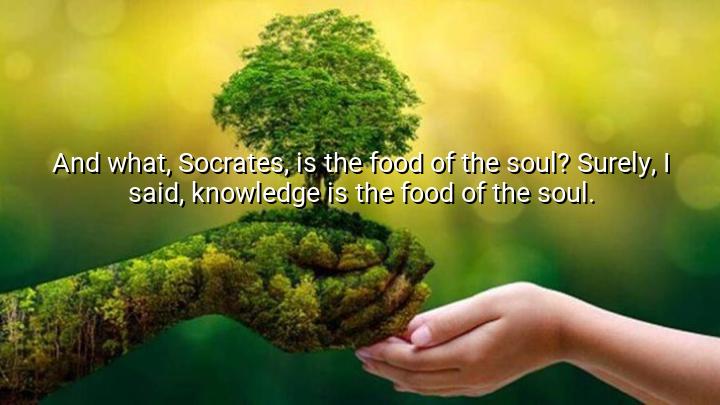




This quote by Plato, one of the most influential philosophers in Western thought, conveys a deep connection between knowledge and the soul. In the passage, the character Socrates is asked what nourishes the soul, and he replies, “knowledge is the food of the soul.” This metaphor suggests that just as the body needs food to grow and survive, the soul—our inner, rational, and moral self—requires knowledge to develop, flourish, and achieve wisdom.
The idea reflects Plato’s belief that the pursuit of truth, understanding, and philosophy is essential to a meaningful life. In his dialogues, especially in works like The Republic and Phaedrus, Plato often emphasizes that the soul is eternal and capable of growth through the acquisition of virtue and insight. By stating that knowledge is the soul’s nourishment, he elevates intellectual and ethical development as the highest forms of human activity.
The origin of this quote appears in Plato’s dialogues, where Socrates, his mentor and the central figure in many of his philosophical texts, engages in thought-provoking discussions. This particular passage reflects Plato's broader educational philosophy, where learning is not simply about information, but about the transformation of the individual. Knowledge, for Plato, leads to self-awareness, justice, and ultimately to alignment with the Forms, especially the Form of the Good.
Ultimately, this quote remains a powerful reminder of the value of learning and the inner nourishment that comes from seeking truth and wisdom. It challenges us to care for our souls as much as we do our bodies, and to recognize that growth, both intellectually and spiritually, is what leads to a fulfilled and enlightened life.

AAdministratorAdministrator
Welcome, honored guests. Please leave a comment, we will respond soon