

An adult human can last 40 days without food, a week without any sleep, three days without water, but only five minutes without air. Yet nothing is more taken for granted than the air we breathe. However, not just any air will do - it must be exquisitely designed to meet our needs. Too little oxygen in the atmosphere will kill us, as will too much.
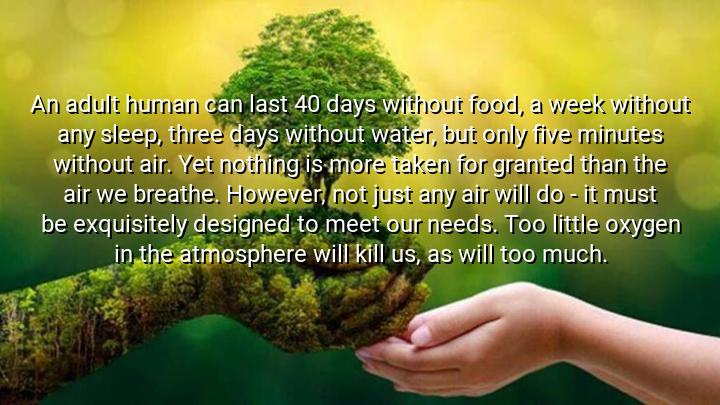




This quote by Hugh Ross, "An adult human can last 40 days without food, a week without any sleep, three days without water, but only five minutes without air. Yet nothing is more taken for granted than the air we breathe. However, not just any air will do – it must be exquisitely designed to meet our needs. Too little oxygen in the atmosphere will kill us, as will too much," emphasizes the delicate balance and fine-tuning of our natural environment, particularly the composition of Earth’s atmosphere. Ross uses a scientific observation to highlight how life-sustaining elements, such as air, are often overlooked precisely because they are so reliably present.
The quote underscores how oxygen, though vital, is only beneficial within a very narrow range. A small variation—either too much or too little—can be fatal, which suggests, in Ross's view, an incredibly precise calibration of the planet's conditions to support human life. By stating that air must be “exquisitely designed,” Ross implies a belief in intelligent design, where the Earth's ability to sustain life is not a random occurrence but a purposeful arrangement.
Hugh Ross is an astrophysicist, Christian apologist, and founder of the organization Reasons to Believe, which seeks to reconcile scientific discoveries with biblical faith. This quote is reflective of his broader efforts to show that the universe and life itself are the products of intentional creation rather than cosmic chance. He frequently discusses the concept of fine-tuning in nature as evidence of a Creator, blending scientific fact with theological interpretation.
Ultimately, Ross’s quote serves as both a scientific reminder and a spiritual reflection. It challenges us to consider the fragile systems that make life possible and to cultivate a deeper gratitude for elements—like the air we breathe—that we often overlook. Whether one views this balance as a product of evolution or divine intent, the quote invites a sense of awe for the intricacy and interdependence of life on Earth.

AAdministratorAdministrator
Welcome, honored guests. Please leave a comment, we will respond soon