

Amazingly when you add life and consciousness to the equation you can actually explain some of the biggest puzzles of science.
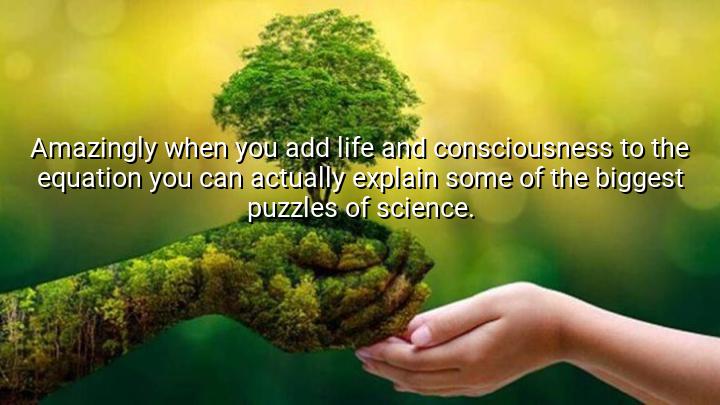




The quote by Robert Lanza — "Amazingly when you add life and consciousness to the equation you can actually explain some of the biggest puzzles of science." — suggests that the concepts of life and consciousness can provide insights into some of the most challenging questions in science. Lanza, a prominent biologist and thinker, proposes that understanding the nature of living organisms and human awareness can help us solve scientific mysteries that traditional approaches might overlook. By incorporating consciousness into the equation, we can expand our understanding of the universe and the phenomena within it.
Lanza’s statement reflects his belief that consciousness is not a secondary or isolated aspect of existence, but rather a key factor in understanding the natural world. In the context of modern science, many complex questions — such as the nature of reality, the origins of the universe, and even the nature of life itself — cannot be fully understood without considering the role of conscious awareness. Lanza advocates for a more holistic view of science that takes into account both objective and subjective aspects of existence.
The origin of this quote is tied to Lanza’s work in biocentrism, a theory he developed that emphasizes the centrality of life and consciousness in understanding the universe. According to Lanza, traditional scientific approaches have neglected the role of consciousness, and by integrating it into our understanding of physics, biology, and cosmology, we can arrive at a more comprehensive explanation of life and the universe.
Ultimately, Lanza’s words encourage a new way of thinking that merges the insights of science with the complexities of consciousness and life. By considering these elements, we open up new possibilities for understanding some of the deepest mysteries of existence. This shift in perspective could help resolve questions that have long puzzled scientists, offering a more integrated view of the universe.

HN12.Thai Huu Nhan
This quote made me think about how science often tries to remain separate from subjective experience, but maybe that’s holding us back. If we included life and consciousness in our equations, would that make our models more complete—or just more complicated? I'm genuinely curious how such a framework could be practically applied in fields like cosmology, physics, or even AI. What do others think—is this the next frontier or a philosophical distraction?
NANguyen An
It's a bold claim that consciousness could help explain the biggest scientific mysteries. But I wonder—does this verge on pseudoscience, or is it a legitimate philosophical shift that science needs to take seriously? Where’s the line between speculative metaphysics and scientific inquiry? I'd be curious to know what kind of empirical support exists for these ideas, especially from neuroscience or quantum physics.
TTTran Tam
This reminds me of the classic chicken-and-egg problem—do we need consciousness to explain the universe, or does the universe give rise to consciousness? If adding life and awareness to scientific equations offers solutions, why hasn't mainstream science embraced this more fully? Is it because it challenges materialist assumptions, or because it's simply too difficult to quantify consciousness in empirical terms?
TVThu Vu
I find this quote both thrilling and unsettling. If consciousness is a fundamental part of understanding science, what does that mean for objectivity? Doesn’t it blur the line between observer and observed? This idea makes me question whether science, as we know it, is missing something crucial. How do we even begin to study consciousness scientifically when it’s so subjective and hard to measure?
GLGia Luc
This quote fascinates me—it flips the usual scientific narrative. We're so used to viewing life and consciousness as byproducts of physical laws, not essential components in explaining them. Could it be that our understanding of reality is incomplete because we've left out the observer? I’d love to explore how this idea connects with theories like quantum mechanics or biocentrism. Are we underestimating the role of perception in shaping the universe?