

All of the biggest technological inventions created by man - the airplane, the automobile, the computer - says little about his intelligence, but speaks volumes about his laziness.
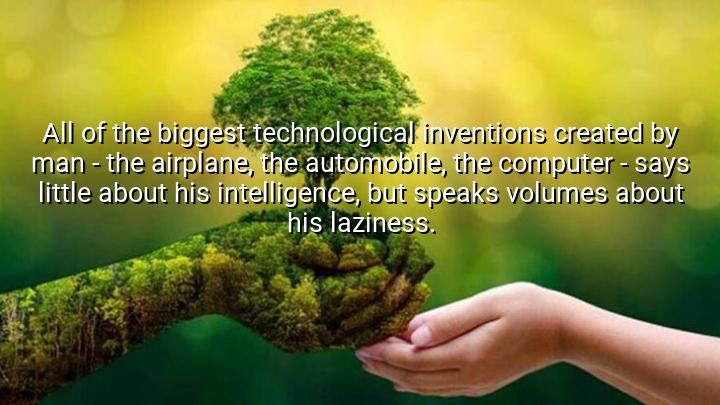




The quote "**All of the biggest technological inventions created by man - the airplane, the automobile, the computer - says little about his intelligence, but speaks volumes about his laziness," by Mark Kennedy, offers a critical perspective on the motivations behind technological innovation. Kennedy suggests that the major advancements in human technology aren't necessarily indicators of intellectual brilliance, but rather solutions born out of a desire to simplify life or avoid effort. The inventions mentioned, such as the airplane, automobile, and computer, are seen not so much as symbols of genius, but of humanity's quest for comfort and convenience.
In this context, Kennedy's words challenge the conventional view that technological progress is always a direct result of intellectual achievement. Instead, he argues that these inventions are driven by the human need to avoid hard work, reduce physical labor, and overcome the limitations of the body. The invention of the airplane allows for quicker travel, the automobile offers convenience, and the computer streamlines processes, all of which could be seen as efforts to reduce the physical and mental demands of daily life.
The origin of this quote likely comes from Kennedy's broader critique of society's dependence on technology. He seems to be questioning whether our constant innovation is always for the betterment of human progress, or if it is simply a response to laziness—a desire to find easier ways of doing things rather than engaging more deeply with the world around us. This view aligns with the notion that technology, while advancing, can sometimes lead to a lack of engagement or effort in more traditional, hands-on tasks.
In a broader sense, Kennedy's quote speaks to the complex relationship between technology and human behavior. While technological innovations have undeniably improved our lives in countless ways, Kennedy challenges us to consider whether they truly reflect our highest intellectual capabilities or are simply convenience-driven solutions to avoid physical or mental exertion. This reflection invites us to think critically about how we approach technology and whether we might be losing touch with the more fundamental aspects of human effort and engagement.

AAdministratorAdministrator
Welcome, honored guests. Please leave a comment, we will respond soon