

All human actions have one or more of these seven causes: chance, nature, compulsions, habit, reason, passion, desire.
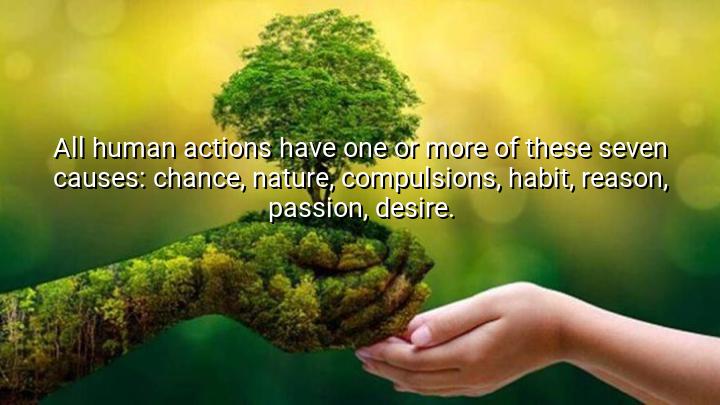




The quote "All human actions have one or more of these seven causes: chance, nature, compulsions, habit, reason, passion, desire" by Aristotle highlights his view that human behavior is influenced by various factors, some of which are internal and others external. According to Aristotle, our actions cannot be attributed to a single cause; rather, they are the result of a combination of forces that shape our decisions and behavior. These seven causes represent a broad spectrum of influences, from the random (chance) to the deliberate (reason), and from the unconscious (habit) to the emotional (passion and desire).
Aristotle’s statement reflects his broader philosophical exploration of human nature and motivation. In his works, particularly in Nicomachean Ethics, he delves into the causes behind human actions and decision-making, attempting to understand what drives people to act in certain ways. For instance, reason is seen as the rational, conscious aspect of human behavior, while passion and desire are driven by emotional and instinctual forces. Compulsions and habit reflect more automatic responses, while nature and chance speak to the role of external factors and natural tendencies in shaping our actions.
The origin of this quote comes from Aristotle’s philosophical writings, where he sought to categorize and understand the complexity of human behavior. By identifying these seven causes, Aristotle attempted to explain why people make choices and how different influences—whether rational, emotional, or external—come together to shape our lives. His philosophy laid the groundwork for much of modern ethics and psychology, as it sought to understand the various elements that drive human actions.
Ultimately, Aristotle’s quote invites reflection on the multiple factors that influence our behavior. It suggests that human actions are not solely the result of one cause, but are instead shaped by a combination of internal and external forces. By recognizing these different causes, we can better understand the complexity of human motivation and the factors that drive our decisions, from rational thought to emotional impulses.

AAdministratorAdministrator
Welcome, honored guests. Please leave a comment, we will respond soon