

A subject for a great poet would be God's boredom after the seventh day of creation.
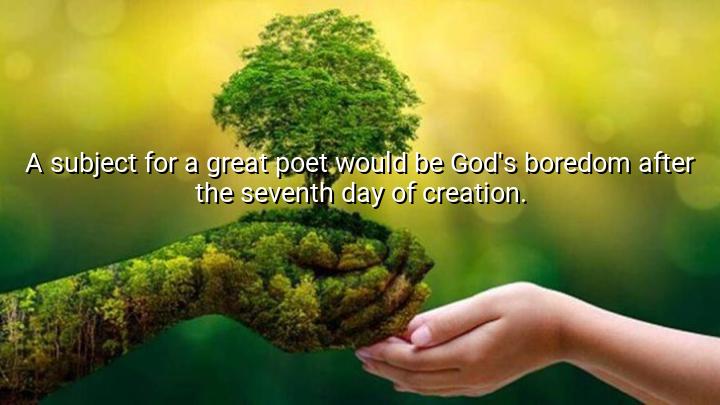




Friedrich Nietzsche’s quote, “A subject for a great poet would be God’s boredom after the seventh day of creation,” explores a provocative and philosophical perspective on the nature of creation and the divine. Nietzsche suggests that after God completed the act of creation in six days, as depicted in the Biblical account, there might be a sense of boredom or emptiness that follows. The idea is that once everything has been created, there is no more challenge or purpose in further action, leading to a state of existential dissatisfaction or restlessness.
This concept reflects Nietzsche's views on the nature of creativity and the human condition. He often explored the theme that once all desires are fulfilled, or once the act of creation is complete, a sense of emptiness can follow. The idea of God’s boredom is a metaphor for the potential disillusionment that comes with the lack of future endeavors or challenges. Nietzsche's suggestion that a great poet could capture this idea reflects his belief in the power of art and poetry to delve into deep, sometimes uncomfortable truths about the world and the nature of existence.
Nietzsche’s use of boredom in this quote also speaks to his broader philosophical critique of traditional religious and existential concepts. By implying that God, the ultimate creator, might experience boredom, Nietzsche is questioning the assumption that completion or perfection necessarily leads to fulfillment. Instead, he points to the idea that once goals or creations are achieved, they may lose their significance, revealing a deeper absurdity in the human search for meaning and purpose.
The origin of this quote comes from Friedrich Nietzsche, a German philosopher known for his works that challenge traditional moral and religious values. Nietzsche often explored the tension between human aspirations, existential purpose, and the limits of traditional religious doctrines. His idea of God's boredom reflects his belief in the fluidity of meaning and the complex relationship between creation and existence, often pushing readers to think critically about the deeper nature of life, divinity, and human creativity.

AAdministratorAdministrator
Welcome, honored guests. Please leave a comment, we will respond soon