

A man's house is his castle.
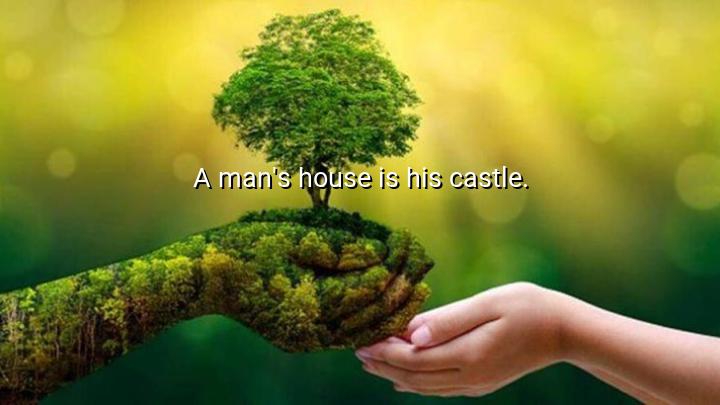




The quote, "A man's house is his castle," is attributed to James Otis, an American lawyer and political activist during the colonial period. In this statement, Otis conveys the principle that a home is a person’s ultimate place of safety, autonomy, and privacy. Just like a castle serves as a fortress for a king, a house should be a sanctuary where an individual has complete control and is protected from unwarranted intrusion. The quote has come to symbolize the broader idea of individual rights and the sanctity of private property.
Otis’s words gained significance in the context of the American colonies’ resistance against British rule. He argued strongly against writs of assistance, which allowed British officials to enter homes without specific cause, violating the colonists’ sense of liberty and privacy. By comparing a man’s house to a castle, Otis emphasized that individuals should enjoy the same level of sovereignty in their homes as monarchs do in their castles. This made the phrase an early rallying cry for freedom and civil rights in America.
The origin of this principle can be traced even further back to English common law, where it was recognized as a foundational idea that a person’s dwelling was inviolable. However, Otis is credited with popularizing and sharpening its meaning in the American context, particularly during the pre-Revolutionary period, where the defense of personal liberty and property rights became central to the colonists’ struggle. His arguments laid some of the groundwork for the Fourth Amendment of the U.S. Constitution, which protects citizens against unreasonable searches and seizures.
Ultimately, the quote underscores the idea of home as a fortress of personal freedom. It reflects the belief that individual rights begin within the home, and that protecting this space is essential for safeguarding broader freedoms. Through Otis’s influence, the phrase has become a timeless expression of the importance of privacy, autonomy, and liberty in democratic societies.

AAdministratorAdministrator
Welcome, honored guests. Please leave a comment, we will respond soon