

A government, for protecting business only, is but a carcass, and soon falls by its own corruption and decay.
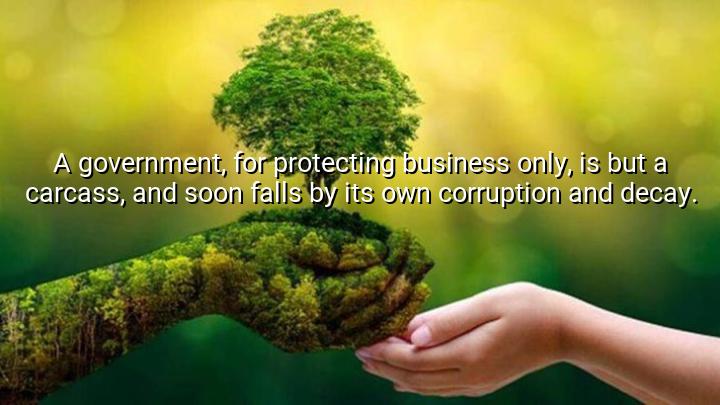




The quote “A government, for protecting business only, is but a carcass, and soon falls by its own corruption and decay” comes from Amos Bronson Alcott, a 19th-century American philosopher, educator, and transcendentalist. In this powerful statement, Alcott warns against a government that serves the interests of commerce and industry alone, neglecting its duty to the public good and moral principles. By describing such a government as a "carcass," he underscores its lack of vitality, justice, and enduring strength.
Alcott's words reflect a deep mistrust of unchecked corporate influence over political institutions. He believed that when business interests dominate the functions of government, corruption inevitably follows. The focus on profit rather than principle leads to decay, both morally and structurally, ultimately resulting in the collapse of the system itself. This is not just a political critique but also a moral indictment.
As a member of the transcendentalist movement, alongside figures like Ralph Waldo Emerson and Henry David Thoreau, Alcott valued individual conscience, social reform, and the pursuit of higher ideals over materialism. His writings and teachings emphasized the need for ethical governance—one rooted in human dignity, not just economic expansion. In this context, the quote serves as a cautionary message against the overreach of capitalism into the soul of democracy.
Ultimately, Alcott's message is timeless: a government must serve all people, not merely business elites. When it forgets this responsibility, it becomes hollow—stripped of its purpose—and cannot withstand the pressures of its own imbalanced priorities. His warning is as relevant today as it was in the 1800s, urging us to reflect on the integrity of leadership and the balance between economy and ethics.

AAdministratorAdministrator
Welcome, honored guests. Please leave a comment, we will respond soon