

A corporation's primary goal is to make money. Government's primary role is to take a big chunk of that money and give it to others.
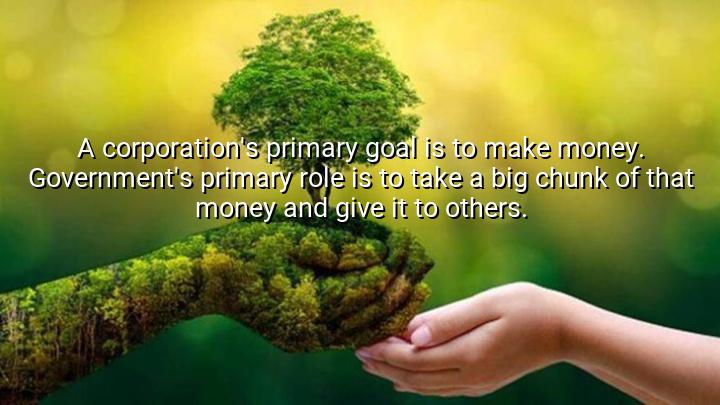




The quote, "A corporation's primary goal is to make money. Government's primary role is to take a big chunk of that money and give it to others," by Larry Ellison, reflects his straightforward perspective on the roles of businesses and governments in society. Ellison, co-founder of Oracle Corporation, is known for his candid views on capitalism and the relationship between the private and public sectors. In this statement, he emphasizes the central focus of a corporation, which is to generate profit for its shareholders, while the role of government is often seen as redistributing wealth, particularly through taxation and social programs.
Ellison's comment highlights the inherent conflict between these two entities. A corporation seeks to maximize revenue and shareholder value, sometimes prioritizing financial gain over social responsibility. On the other hand, he suggests that government functions as a redistributive force, taking a portion of corporate profits through taxation and allocating those funds for public services or welfare. This redistribution can be controversial, as it reflects differing ideologies on how wealth should be managed in a society.
The statement also points to the tension that exists in many capitalist societies between profit-making businesses and government intervention. While businesses may resist paying high taxes, governments argue that taxation is necessary to fund essential public goods, such as education, healthcare, and infrastructure. Ellison's perspective implicitly critiques the government’s role in wealth redistribution, questioning the balance between economic growth and social welfare.
This quote underscores a recurring debate in modern economics: how to ensure that the wealth generated by corporations benefits society as a whole. While capitalism encourages innovation and economic growth, it also raises questions about the fairness of wealth distribution and the role of government in addressing inequality. Ellison’s words reflect the viewpoint that businesses and government have very different, often conflicting, priorities in how they interact with wealth.

AAdministratorAdministrator
Welcome, honored guests. Please leave a comment, we will respond soon