

A cardinal principle of Total Quality escapes too many managers: you cannot continuously improve interdependent systems and processes until you progressively perfect interdependent, interpersonal relationships.
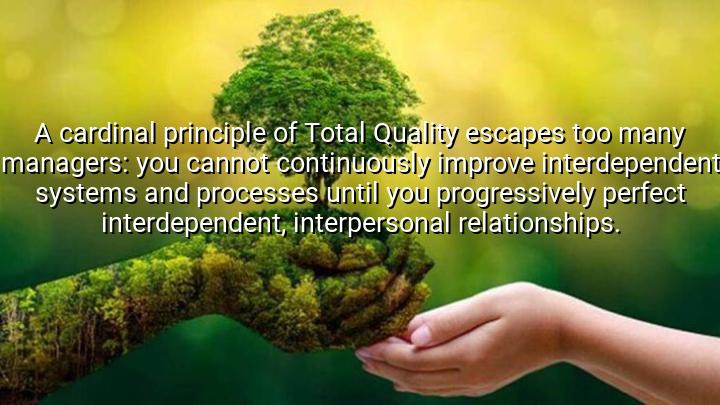




Stephen Covey, the influential author of The 7 Habits of Highly Effective People, made this statement to emphasize the human element in Total Quality Management (TQM). He highlights that many managers focus heavily on improving systems and processes but overlook the fact that these are operated by people. The quote underscores that interpersonal relationships must be nurtured and perfected for any lasting improvement in complex, interdependent systems.
Covey’s use of the term “interdependent” is key. In most organizations, success is the product of multiple teams and individuals working together. Without strong communication, trust, and collaboration, attempts at improving systems or processes often fail or produce only temporary gains. He is reminding leaders that people form the foundation of any quality initiative, and neglecting relationships undermines organizational effectiveness.
The origin of the quote is rooted in Covey’s broader philosophy of principle-centered leadership, where human values and relationships are seen as central to sustainable success. During the rise of Total Quality Management in the late 20th century, many organizations sought quick fixes through process optimization, but Covey insisted that true quality improvement begins with the way people treat and work with each other.
Ultimately, Covey’s message is that continuous improvement is not just a technical exercise; it is deeply human. By progressively perfecting interpersonal relationships, organizations create an environment of mutual respect and trust where systems and processes can evolve effectively and sustainably.

AAdministratorAdministrator
Welcome, honored guests. Please leave a comment, we will respond soon